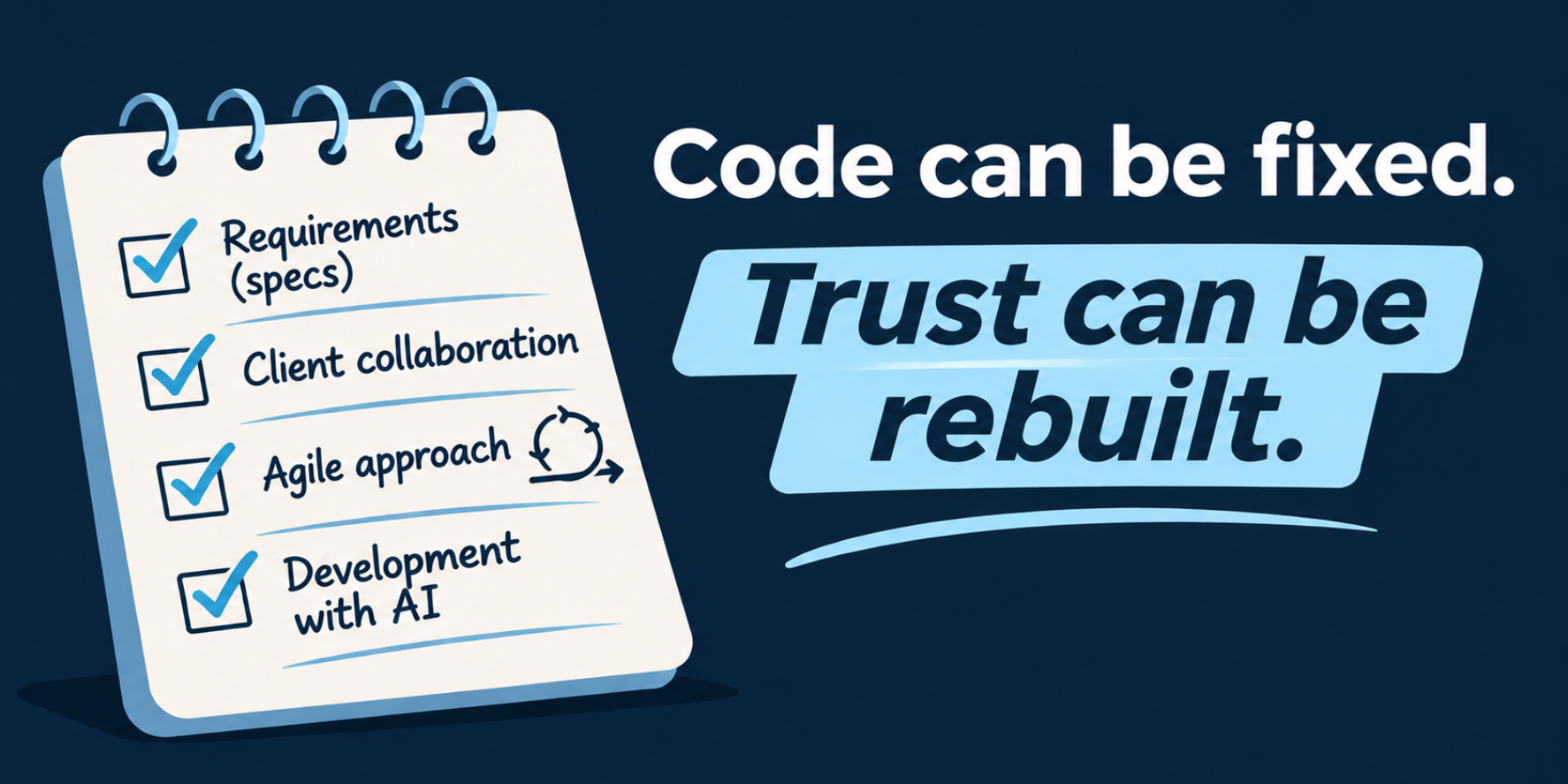
Code can be fixed. Trust can be rebuilt. But a missed opportunity may never come again.
After more than 30 years in IT, I’ve learned that a project can fail even when its technical problems are entirely fixable. We place considerable importance on code quality, technology choices, and deadlines. Yet one factor can undermine all that work: the gap between what a client expects and what the development team believes it needs to deliver.
That gap may seem minor from a technical perspective, but its human and business consequences can be significant.
A Promising Business Opportunity
Imagine a development team invited to build a demonstration application for a company looking to select a new technology partner. The opportunity could lead to a major contract and a long-term business relationship.
The client provides a reasonably clear description of the application. The main features are identified, and the team has the necessary expertise. Development progresses quickly, partly thanks to AI-powered tools, and a working application is ready for the presentation.
But when demo day arrives, the meeting takes an unexpected turn.
The client asks questions about behaviors that were never specified. They look for features that weren’t included in the original requirements and seem to expect different results. The team explains its decisions and points out that many of these requests could be addressed in another development iteration.
Technically, none of the issues seem particularly difficult to resolve. Yet the initial enthusiasm begins to fade, and the discussion increasingly focuses on what’s missing rather than what has been accomplished. What was supposed to be an opportunity to demonstrate the team’s expertise turns into an attempt to explain the application’s limitations.
When Disappointment Costs More Than Fixing the Code
A few days later, the company announces that it has decided not to move forward with the team. The contract is lost, despite a working application and issues that could probably have been resolved quickly.
This is one of the most frustrating aspects of such situations: the feeling of having missed an opportunity when you had everything needed to succeed. The demonstration may not have failed technically, but it failed to convince the client.
It would be easy to blame the client for poorly defining their needs. However, some expectations may seem so obvious to them that they never think to mention them. Meanwhile, a development team can meet every documented requirement without fully understanding the expectations behind them.
Neither side necessarily made a serious mistake, yet the outcome remains the same: an important opportunity has been lost.
Requirements Don’t Always Tell the Whole Story
A requirements document can be clear without capturing everything a client expects. We need to distinguish between stated requirements, the organization’s actual business needs, and the criteria that will determine whether the outcome is considered successful.
Ideally, these elements should align, but that isn’t always the case. An application may satisfy the documented requirements without fully matching how the client envisioned it working.
I believe thorough requirements analysis is one of the best investments we can make in a software project. If artificial intelligence allows us to write code faster, why not spend more time understanding what we actually need to build?
That doesn’t mean producing a requirements document hundreds of pages long. Instead, we should focus on documenting objectives, business processes, constraints, priorities, and acceptance criteria.
For a demonstration, one additional question becomes essential: What criteria will the client use to evaluate the result? A proof of concept, a prototype, and a nearly complete application serve different purposes and come with different expectations.
Communication and Agile Development
Good collaboration begins before the first line of code is written. Clients need to explain their business context and objectives, but service providers also have a responsibility to ask the right questions, identify ambiguities, and confirm their understanding.
I explore this topic further in my resource, How to Prepare a Web Development Service Request, which outlines the information needed to prepare a request for proposals or a requirements document.
An Agile approach helps maintain this collaboration throughout development. By regularly involving the client, developers, analysts, and end users, the team can validate assumptions, demonstrate features incrementally, and address misunderstandings before they become costly.
Agile doesn’t eliminate the need to document requirements. Instead, it encourages useful, evolving documentation supported by ongoing communication. For a one-time demonstration, where multiple iterations may not be possible, validating expectations beforehand becomes even more important.
Using Artificial Intelligence to Improve Understanding
Much of the discussion around AI focuses on its ability to accelerate coding. Yet it can also help structure requirements documents, identify ambiguities, suggest use cases, and develop acceptance criteria.
AI cannot replace meaningful conversations with clients, nor can it reliably uncover every expectation that was never expressed. But it can help us ask better questions before development begins.
Over the years, I’ve become increasingly aware of the difference between a technically successful implementation and a genuinely successful project. The latter requires more than technical expertise. It also demands listening, analysis, and an understanding of human expectations.
Tools change and methodologies evolve, but our responsibility remains the same: to make sure we’re building the right solution, for the right reasons, with the right people.
Because code can be fixed and trust can be rebuilt. But a missed opportunity may never come again.